
US Marines’ Daring Role in Venezuela Oil Tanker Seizure: A Bold Strike Against Maduro’s Regime
In a high-stakes operation that underscores escalating US-Venezuela tensions, US Marines played a pivotal role in the dramatic seizure of the oil tanker Skipper off Venezuela’s coast on December 10, 2025. This audacious move, part of President Donald Trump’s aggressive pressure campaign against Nicolás Maduro’s socialist government, not only disrupted a multimillion-dollar illicit oil network but also highlighted the Marines’ elite boarding expertise in modern maritime interdictions. As the Trump administration vows to target more sanctioned vessels, the Skipper incident—dubbed an “act of piracy” by Caracas—marks a turning point in America’s Caribbean strategy.
The operation unfolded under the cover of dawn in the southern Caribbean, where the US has maintained a robust naval presence since August 2025 to combat drug trafficking and enforce sanctions. The Skipper, a 20-year-old “dark fleet” vessel flagged under a shadowy Liberian registry, had slipped out of a Venezuelan port laden with 1.8 million barrels of heavy crude oil—valued at over $95 million. US intelligence tracked the tanker for months, revealing its ties to smuggling operations funneling sanctioned Venezuelan and Iranian oil to fund terrorist groups like Hezbollah and Iran’s Islamic Revolutionary Guard Corps-Quds Force. Prior to the seizure, the crew had offloaded 200,000 barrels in a covert transfer, underscoring the tanker’s role in evading global sanctions imposed since 2022.
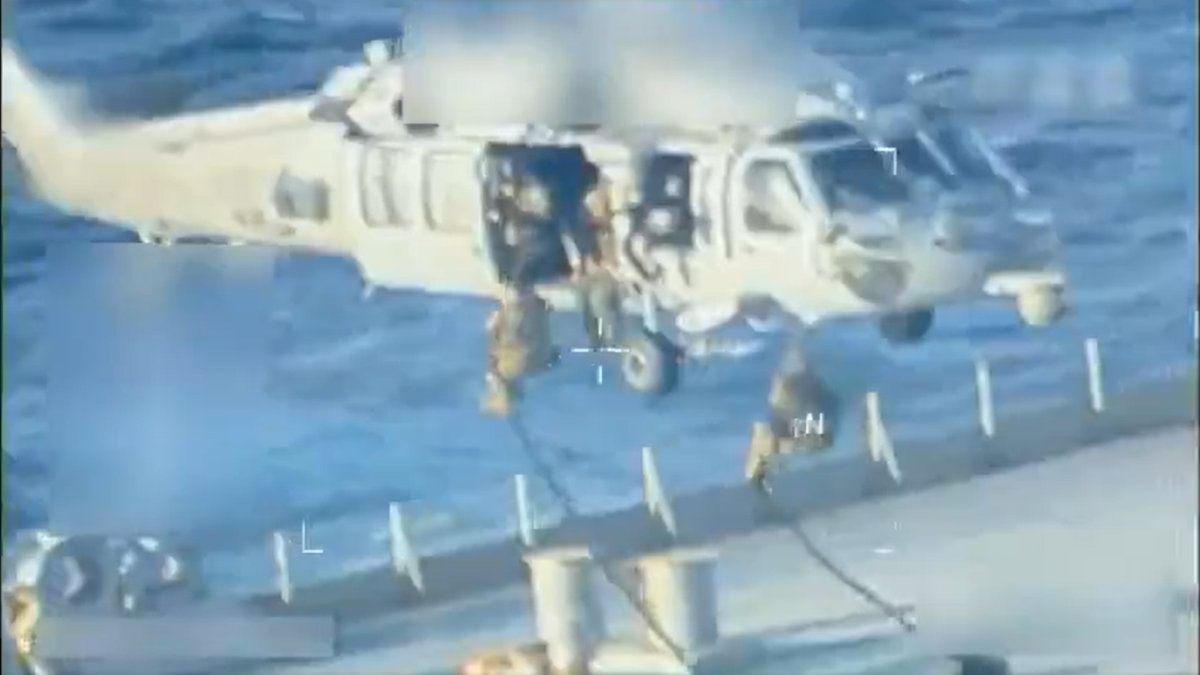
Leading the charge was the US Coast Guard, with support from the Navy, FBI, and Homeland Security Investigations. But it was the 10 US Marines from the elite Maritime Special Purpose Force who stole the spotlight, boarding the vessel alongside 10 Coast Guard members and special operations teams. Video footage released by the Pentagon captured the intensity: Two MH-60 helicopters swooped in from the USS Gerald R. Ford carrier strike group, hovering low as camouflaged Marines rappelled down ropes, weapons drawn, in a textbook fast-rope insertion. The elite Coast Guard Maritime Security and Response Team, trained for counterterrorism and high-risk boardings, secured the deck within minutes, detaining the 22-person crew without resistance. No shots were fired, but the precision spoke volumes about inter-agency coordination honed in exercises like RIMPAC.
For the Marines, this wasn’t just another drill. Stationed aboard amphibious assault ships in the region, their involvement leveraged decades of expeditionary warfare expertise—from Iraq’s oil platform takedowns to counter-piracy ops off Somalia. “These warriors embody the ‘Semper Fi’ spirit, projecting American resolve where tyrants peddle chaos,” said Defense Secretary Pete Hegseth in a briefing, linking the seizure to broader efforts against fentanyl flows and the Tren de Aragua gang, now designated terrorists.
The Skipper’s cargo, now en route to a US port under Coast Guard escort, represents a windfall for Washington’s sanction enforcement. Trump, announcing the bust during a White House meeting with business leaders, quipped, “We’re keeping the oil—America needs it, not Maduro’s cronies.” Homeland Security Secretary Kristi Noem tied it to anti-drug initiatives, noting the tanker’s history of faked GPS signals to dodge trackers.
Venezuela’s backlash was swift and fiery. Foreign Minister Yvan Gil branded the raid “international piracy,” accusing the US of coveting the nation’s vast oil reserves—the world’s largest—to topple Maduro. Russian President Vladimir Putin, a Maduro ally, reaffirmed support, while analysts warn of over 30 similar tankers now at risk, potentially sparking a naval cat-and-mouse game in the oil-rich Orinoco Basin.
As the Skipper steams toward Texas refineries, this Marine-led seizure signals a new era of “maximum pressure” in the Americas. It not only starves Maduro’s war chest but reaffirms US Marines’ unmatched versatility—from beach assaults to black-ops boardings. In an age of hybrid threats, their actions remind the world: When freedom’s at stake, the few become the unbreakable shield.
0 Comments